Vectors and linear combinations
Lecture 2
Vectors in \(\mathbb{R}^n\)
\[ \vec{v}=\begin{bmatrix}a_1\\a_2\\\vdots\\a_n\end{bmatrix} \]
Euclidean space
For some \(n\in\mathbb{N}\), the Euclidean space of dimension \(n\) is the set of all \(n\)-tuples \[ (a_1,a_2,\dots,a_n) \] where each \(a_i\in\mathbb{R}\).
Cartesian coordinate system
- By interpreting each entry as a coordinate, we may interpret \((a_1,a_2,\dots,a_n)\) as a point in \(n\)-dimensional space.
- For example, when \(n=2\), \((3,-1)\) is a point on the plane, and when \(n=3\), \((-1,0,2)\) is a point in 3-dimensional space.
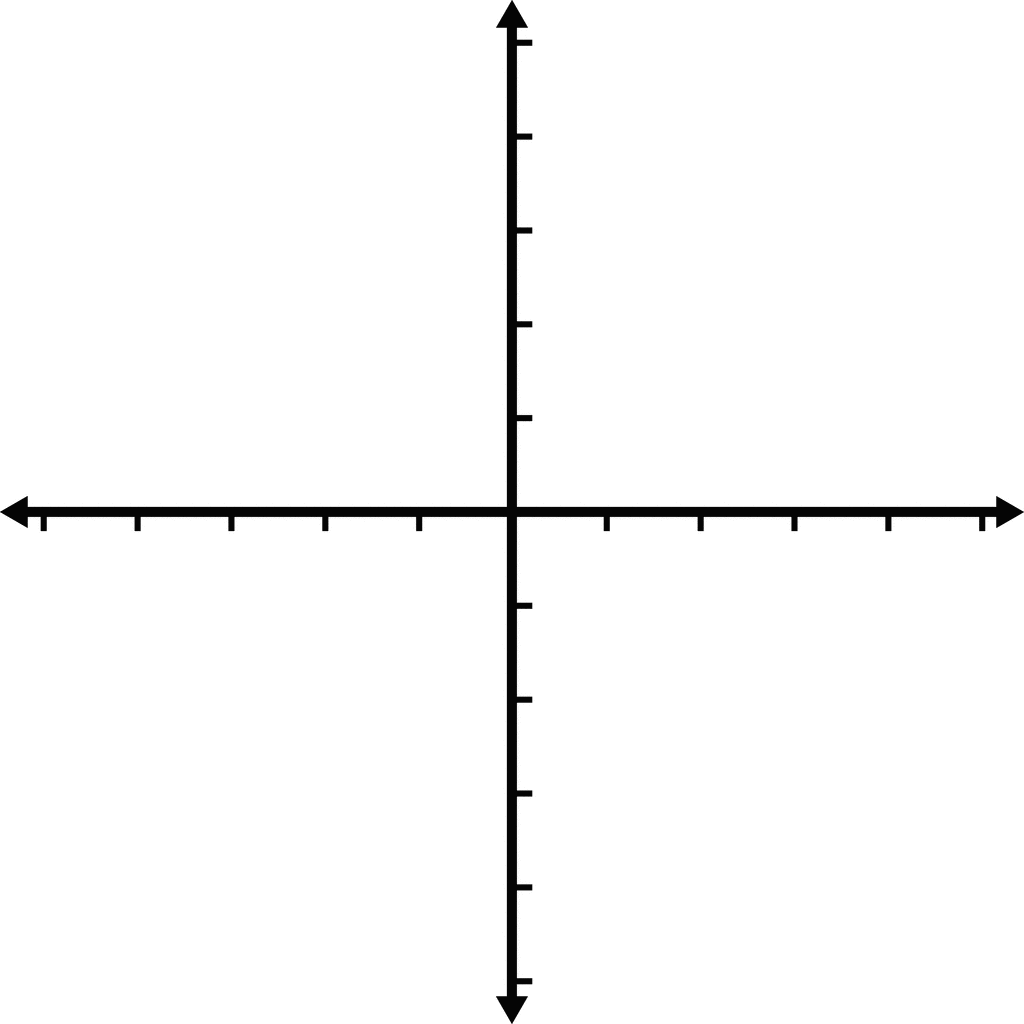

How we locate a point
Unconsciously, when we are given coordinates, we do something like this:
- Locate the origin \((0,0)\).
- Move \(2\) units in the \(x\) direction.
- Move \(-3\) units (i.e., \(3\) units downward) in the \(y\) direction.
The last two steps are interchangeable: the order does not matter.
What if…
- We change the origin?
- We swap the \(x\) and \(y\) axes?
- We tilt the axes?
- We change the unit (inches vs. centimeters)?
- These questions lead to the idea of vectors and linear combinations.
Coordinates for movement
We now interpret \((2,-3)\) as an instruction for movement:
- Let the “unit step in the \(x\) direction” be \(\vec{e}_1\) and the “unit step in the \(y\) direction” be \(\vec{e}_2\). Then \[ (2,-3)=2\vec{e}_1-3\vec{e}_2. \]
- In words: “move \(2\) units in the \(\vec{e}_1\) direction and \(-3\) units in the \(\vec{e}_2\) direction.”
- A unit step in each direction can be naturally represented by \(\vec{e}_1=(1,0)\) and \(\vec{e}_2=(0,1)\).
- With this interpretation, the previous arithmetic agrees with ordinary coordinate-by-coordinate algebra!
- In particular, it makes sense to write \[ (2,-3)=2*(1,0)-3*(0,1). \] where the operations are carried out coordinate by coordinate.
Points vs. vectors
- Consider two coordinate pairs: \((2,-3)\) and \((1,1)\).
- Does it make sense to add two points?
- It makes sense if we interpret \((a_1,a_2)\) as an instruction for movement (a vector).
- As vectors, \((2,-3)+(1,1)\) means: do the movement \((2,-3)\), then do the movement \((1,1)\): \((2,-3)+(1,1)=(3,-2)\).
Column vector representation
To emphasize that this object represents a vector, rather than a point, we often write \[ \vec{v}=\begin{bmatrix}a_1\\a_2\\\vdots\\a_n\end{bmatrix}\qquad\text{or}\qquad \vec{v} = \langle a_1, a_2, \dots, a_n\rangle. \] We write vectors vertically, as columns, for convenience and consistency—this choice will become clear later in the course.
Arrow representations of a vector
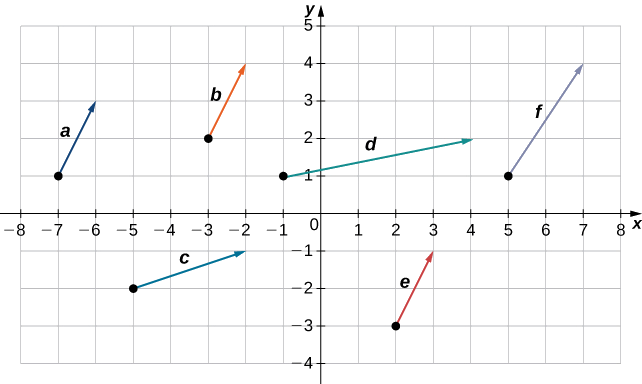
- If we start at the origin and follow \(\vec{v}\), the endpoint is the point with coordinates \((a_1,\dots,a_n)\).
- So we often draw \(\vec{v}\) as an arrow from the origin to that point.
- But a vector is an instruction for movement, so we can start from any point, not just the origin.
- Therefore, many different arrows (same direction and length) represent the same vector.
Scalars and vectors
In examples like \((2,-3)=2\vec{e}_1-3\vec{e}_2\), there are two kinds of quantities: the magnitudes (\(2\) and \(-3\)) and the directions (\(\vec{e}_1\) and \(\vec{e}_2\)).
- A scalar is a real number \(c\in\mathbb{R}\) (a magnitude).
- A vector \(\vec{v}\) represents both a direction and a magnitude.
Elementary linear combination
In general, the vector \(\langle a_1,a_2,\dots,a_n \rangle\) in \(\mathbb{R}^n\) is the movement along each axis direction by the given magnitudes.
Equivalently, \[ \langle a_1,a_2,\dots,a_n \rangle =a_1\vec{e}_1+a_2\vec{e}_2+\cdots+a_n\vec{e}_n, \] where \(\vec{e}_i\) is the unit vector in the \(i\)th coordinate direction (the standard basis vector).
Vector operations
We define two fundamental operations for vectors \(\vec{v},\vec{w}\in\mathbb{R}^n\) and a scalar \(c\in\mathbb{R}\).
1. Vector addition \[ \vec{v}+\vec{w} = \begin{bmatrix}v_1\\ \vdots\\ v_n\end{bmatrix} + \begin{bmatrix}w_1\\ \vdots\\ w_n\end{bmatrix} = \begin{bmatrix}v_1+w_1\\ \vdots\\ v_n+w_n\end{bmatrix}. \]
Vector operations (continued)
2. Scalar multiplication \[ c\vec{v} = c\begin{bmatrix}v_1\\ \vdots\\ v_n\end{bmatrix} = \begin{bmatrix}cv_1\\ \vdots\\ cv_n\end{bmatrix}. \]
Geometric viewpoint of vector operations
1. Vector addition: placing two vectors head-to-tail; equivalently, the sum is given by the diagonal of the parallelogram formed by the two vectors.
2. Scalar multiplication:
- If \(|c| > 1\), the vector is stretched.
- If \(|c| < 1\), the vector is shrunk.
- If \(|c| = 1\), the vector’s magnitude remains unchanged.
If \(c < 0\), the direction of the vector is reversed.
Linear combinations
Suppose we are given vectors \(\vec{v}_1,\dots,\vec{v}_k\). A vector \(\vec{w}\) of the form \[ \vec{w}=c_1\vec{v}_1+\cdots+c_k\vec{v}_k \] is called a linear combination of \(\vec{v}_1,\dots,\vec{v}_k\) with coefficients \(c_1,\dots,c_k\in\mathbb{R}\).
Example
Let \[ \vec{v}_1=\begin{bmatrix}2\\-3\end{bmatrix}, \qquad \vec{v}_2=\begin{bmatrix}1\\0.5\end{bmatrix}. \] Compute \(\vec{w}=3\vec{v}_1-2\vec{v}_2\).
First, \[ 3\vec{v}_1 = 3\begin{bmatrix}2\\-3\end{bmatrix} = \begin{bmatrix}6\\-9\end{bmatrix}. \]
Example (continued)
Next, \[ -2\vec{v}_2 = -2\begin{bmatrix}1\\0.5\end{bmatrix} = \begin{bmatrix}-2\\-1\end{bmatrix}. \]
So \[ \vec{w} = \begin{bmatrix}6\\-9\end{bmatrix} + \begin{bmatrix}-2\\-1\end{bmatrix} = \begin{bmatrix}4\\-10\end{bmatrix}. \]